

When the OEM Stops Making It: Custom Manufacturing Keeps Critical Equipment Running
Obsolescence is an unavoidable reality in industrial operations.
Equipment can remain productive for decades, but the components that keep it running do not always remain available for decades. Manufacturers discontinue product lines, designs change, tooling disappears, and eventually a maintenance team discovers that a critical bearing, assembly, or mechanical component simply cannot be reordered.
That does not necessarily mean the equipment has reached the end of its useful life.
With our team at Bearings Manufacturing Company (BMC), custom manufacturing and reverse engineering can provide another path. Instead of redesigning an entire system around what is currently available, they can evaluate the component the equipment was originally designed to use and determine whether it can be reproduced.
A recent project is a perfect example.
THE CHALLENGE: A Critical Assembly With No Replacement
An industrial customer needed an OEM bearing assembly that had been discontinued. The original manufacturer no longer produced or supported the assembly, and there was no direct replacement available.
Making matters more complicated, annual usage was low, approximately 10 to 20 assemblies per year. That volume can create its own sourcing challenge. It is enough demand to make the component important, but often not enough to attract traditional high-volume manufacturing sources.
The customer needed something very different:
- A dependable replacement for an obsolete OEM assembly
- Manufacturing based on the original component
- Low-volume production without an excessive purchasing commitment
- Predictable availability for maintenance and production planning
- Material traceability and supporting documentation
- A long-term source rather than another temporary workaround
This is exactly where custom manufacturing becomes valuable.
When an original drawing or current manufacturer source is unavailable, the physical component itself can become the starting point.
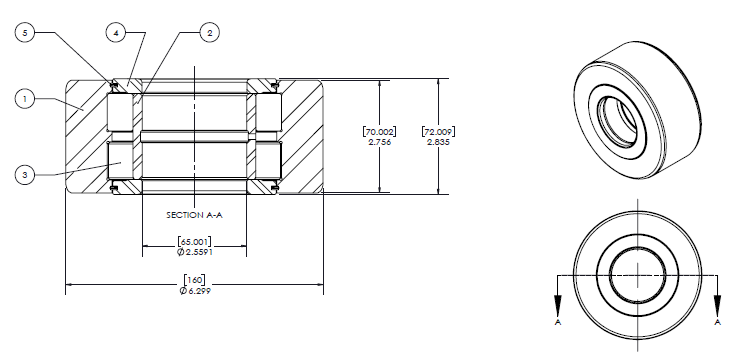
BMC reverse engineered the original OEM assembly to establish the information necessary to manufacture a replacement. The resulting BMC equivalent became a repeatable manufactured component rather than a one-time repair.
This distinction matters.
Reverse engineering is not simply measuring a few dimensions and machining something that looks similar. A component must be understood in the context of its function. Dimensions, fits, geometry, materials, mating surfaces, operating conditions, and other application-critical characteristics all influence whether a replacement will perform as intended.
The goal is to recreate the functionality required by the application while establishing a controlled manufacturing path that can be repeated when the next replacement is needed.
Custom Manufacturing Does Not Have to Mean High Volume
One of the misconceptions surrounding custom manufacturing is that it only makes economic sense when hundreds or thousands of pieces are required.
Industrial replacement parts often operate under very different economics.
If a machine depends on a particular component, annual quantity may be small while the operational value of that component is enormous. Ten pieces per year may not represent a large production program, but those ten components can support equipment worth hundreds of times their purchase price.
For this project, BMC established a low-volume manufacturing program specifically around the customer's ongoing replacement requirements. Production could be scheduled according to anticipated demand rather than forcing the customer into a large manufacturing commitment simply to obtain a usable quantity.
That approach provides another benefit: supply planning.
Instead of waiting until the last spare is installed to begin searching for a discontinued component again, a repeatable manufacturing source gives maintenance and purchasing teams an option they can incorporate into their planning.
Domestic Manufacturing With Documentation Behind It
Availability is important, but manufacturing a critical industrial component requires more than simply producing the correct dimensions.
For this program, BMC utilized 100% domestic raw materials and supplied applicable material certifications and manufacturing documentation. The finished assemblies were also supported by a standard one-year manufacturer warranty.
That creates something an improvised replacement cannot always provide: traceability.
For maintenance, engineering, purchasing, and quality teams, knowing where a component came from and having documentation behind its manufacture can be just as important as having the component itself.
Turning an Obsolete Part Into a Repeatable Supply Program
The real success of the project was not simply manufacturing one replacement.
It was creating a supply path where none existed before.
Several orders in the program were completed in as little as 15 weeks, although actual lead time varied according to material availability and active production workloads. More importantly, the customer was no longer completely dependent on an OEM that had discontinued the assembly.
The project delivered:
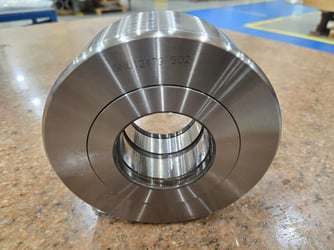
- A replacement source for an obsolete OEM assembly
- Repeatable domestic manufacturing
- Support for relatively low annual quantities
- Flexible production scheduling
- Certified materials and manufacturing documentation
- A manufacturer-backed warranty
- Greater long-term supply continuity
- The ability to extend the service life of existing equipment
That last point may be the most important.
Before You Redesign the Equipment, Look at the Component
When a component becomes obsolete, the first assumption is often that the equipment must be modified to accept something currently available.
Sometimes that is the right solution.
Sometimes it creates an entirely new engineering project involving shafts, housings, seals, mounting arrangements, adjacent components, installation procedures, and inventory changes.
Before taking that route, it is worth asking a different question:
Can the original component be manufactured?
For specialized bearings, bearing assemblies, housings, and other industrial components, reverse engineering and low-volume manufacturing may provide a much more direct solution.
The right approach depends on the application, condition of the original component, technical requirements, material availability, required quantity, and manufacturing feasibility. But "obsolete" should not automatically be interpreted as "unavailable forever."
From One Component to a Long-Term Solution
Custom manufacturing is ultimately about solving problems that standard inventory cannot.
-
A discontinued OEM component.
-
An unusual configuration.
-
A replacement that no longer exists.
-
A quantity too small for conventional production.
-
A machine that still has years of useful service ahead of it.
These are exactly the situations where BMC's manufacturing capabilities can bridge the gap between what the application requires and what the traditional supply chain can provide.
Frequently Asked Questions About Custom Manufacturing
Can an obsolete bearing or component be reverse engineered?
Yes. In many cases, an existing component can be evaluated and reverse engineered to determine whether a replacement can be manufactured. Dimensions, materials, fits, geometry, operating requirements, and other critical characteristics may all be considered during the evaluation.
Do I need an original drawing to have a component manufactured?
Not necessarily. Original drawings and specifications are helpful when available, but an existing sample may provide enough information to begin evaluating the component for reverse engineering. The requirements will depend on the complexity and application of the part.
Can BMC manufacture small quantities of custom components?
Yes. Low-volume manufacturing can be especially valuable for replacement and maintenance applications where only a limited number of components are needed each year. In one BMC program, annual demand was approximately 10 to 20 assemblies, allowing the customer to maintain a dependable replacement source without committing to high-volume production.
How long does custom manufacturing take?
Lead times vary depending on the component, material availability, manufacturing processes, quantity, and current production schedules. In the project highlighted in this article, several orders were completed in as little as 15 weeks.
Are custom manufactured components made with domestic materials?
Domestic sourcing is available depending on the specific project and material requirements. For the project featured here, BMC manufactured the replacement assembly using 100% domestic raw materials and supplied applicable material certifications and manufacturing documentation.
What information should I provide for a custom manufacturing request?
Start with whatever information you have. This might include:
-
- An existing component or sample
- OEM or manufacturer part numbers
- Drawings or dimensional information
- Material specifications
- Application and operating information
- Estimated annual usage
- Required quantity
- Known performance or quality requirements
The more information available at the beginning of the project, the easier it is to determine the appropriate manufacturing path.
Is custom manufacturing always better than redesigning equipment?
No. Every application should be evaluated individually. In some situations, converting equipment to accept a readily available component may make more sense. In others, reverse engineering and manufacturing the original component can avoid additional modifications to shafts, housings, seals, mounting arrangements, or other parts of the system.
What types of problems are a good fit for custom manufacturing?
Custom manufacturing is worth exploring when a component has been discontinued, has no direct replacement, is difficult to source, requires an unusual configuration, or is needed in quantities that make conventional production sourcing difficult.
Where do I start if I have an obsolete or hard-to-find component?
Start with BDS and BMC. Send us your part information, drawings, specifications, or an existing sample. Our team can review the application and help determine whether reverse engineering, bearing modification, or custom manufacturing offers the most practical solution.

Two Companies. One Solution.
BDS and BMC work together to provide solutions that go beyond the shelf. BDS brings extensive bearing inventory, sourcing expertise, and application support, while BMC adds domestic manufacturing, bearing modification, reverse engineering, and custom manufacturing capabilities.
Together, we can help customers solve challenges ranging from everyday bearing requirements to obsolete, hard-to-find, and highly specialized components.
When a standard bearing isn't the answer, our capabilities don't stop there.
Two companies. One team. One solution.