

Dive into the intricate world of Angular Contact Ball Bearings with our comprehensive guide that delves into the design, functionality, and advantages of these essential mechanical components. From handling both radial and axial loads to their ability to support high speeds and precise positioning, Angular Contact Ball Bearings are a vital element in the realm of rotating machinery. Whether you're an engineer seeking efficiency or a technician aiming for optimal performance, understanding the nuances of these bearings is paramount.
What Are Angular Contact Ball Bearings?
Angular contact ball bearings are bearings designed to handle both radial and axial loads simultaneously. They use a contact angle between the balls and raceways to support thrust loads in one direction while maintaining high-speed rotational performance. These bearings are commonly used in machine tools, electric motors, pumps, aerospace equipment, robotics, and automotive applications where precision and load capacity are critical.
Join us as we explore the different types of Angular Contact Ball Bearings, from single row to four-point contact bearings, each offering unique benefits and applications. Stay tuned for insights on proper installation, maintenance, and lubrication techniques to ensure the longevity and reliability of these bearings. Discover the diverse range of industries where Angular Contact Ball Bearings are indispensable, from automotive systems to aerospace equipment, showcasing their versatility and importance in various machinery applications.
Understanding Angular Contact Ball Bearings
Angular Contact Ball Bearings are a type of rolling element bearing designed to handle both radial and axial loads. They are commonly used in applications where there is a need for high rotational speeds and precise positioning.
The components of an angular contact ball bearing include single row, double row, and four-point contact bearings, each with its own unique design and characteristics. These bearings are typically made from materials such as steel, ceramic, or hybrid combinations to ensure durability and efficiency.
When it comes to the cage design and ball arrangement of an angular contact ball bearing, precision and efficiency are key factors to consider. The cage design plays a crucial role in maintaining the proper spacing and alignment of the balls within the bearing, ensuring smooth operation and optimal load distribution. By utilizing advanced engineering techniques, manufacturers can create cages that provide the necessary support for high-speed applications while minimizing friction and wear. Additionally, the ball arrangement within the bearing is carefully designed to maximize contact angles and load-carrying capacity, allowing the bearing to effectively handle both radial and axial loads.
What Is the Contact Angle in an Angular Contact Ball Bearing?
The contact angle is the angle formed between the line connecting the ball-to-raceway contact points and a line perpendicular to the bearing axis. Common contact angles include 15°, 25°, 30°, and 40°. Larger contact angles increase axial load capacity, while smaller angles are better suited for higher rotational speeds.
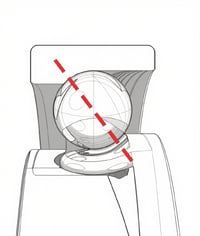 These bearings have a contact angle that allows them to support high axial loads in one direction while still providing some radial support. Understanding the design and functioning of Angular Contact Ball Bearings is crucial for engineers and technicians working with rotating machinery.
Angular Contact Ball Bearings offer several advantages over other types of bearings. Because, they have a higher load carrying capacity and can handle both radial and axial loads simultaneously, it allows for more compact designs and reduces the need for separate bearings to handle different types of loads. Angular Contact Ball Bearings also have lower friction and can operate at higher speeds, making them ideal for applications requiring high precision and efficiency.
What Are the Different Types of Angular Contact Ball Bearings?
There are several different types of Angular Contact Ball Bearings available, each with its own specific design and characteristics. The most common types include single row, double row, and four-point contact bearings.
Single Row Angular Contact Ball Bearings have a single row of balls and are suitable for applications with relatively light axial loads. When it comes to Single Row Angular Contact Ball Bearings, their design characteristics play a crucial role in their performance. Their unique design allows them to handle both radial and axial loads with efficiency, making them a versatile choice for various machinery. Engineers and technicians appreciate their compact design, which reduces the need for separate bearings to handle different types of loads. The lower friction and ability to operate at higher speeds make Single Row Angular Contact Ball Bearings ideal for applications requiring high precision and efficiency. Whether in automotive systems, machine tools, or aerospace equipment, these bearings prove their reliability and durability, showcasing their importance in the world of mechanical components.
Double Row Angular Contact Ball Bearings have two rows of balls and their design characteristics set them apart in the world of mechanical components. These bearings excel at handling higher axial loads, making them a reliable choice for applications requiring robust support. Engineered for efficient distribution of both radial and axial loads, this type of bearing ensures smooth operation and optimal performance. Engineers and technicians appreciate the versatility of Double Row Angular Contact Ball Bearings, as they can accommodate a wide range of machinery needs with ease. Whether in heavy-duty industrial equipment or precision medical devices, these bearings prove their worth by providing the necessary support for high-speed and high-load applications.
Four-Point Contact Bearings have a unique design that allows them to handle both radial and axial loads in any direction. Four-Point Angular Contact Bearings are a remarkable innovation in the world of mechanical engineering, making them a versatile choice for a wide range of applications. Engineered with precision, these bearings provide efficient support and optimal performance, ensuring smooth operation even under high-speed and high-load conditions. Their ability to handle both types of loads simultaneously reduces the need for separate bearings, leading to more compact and efficient designs. Whether in automotive systems, machine tools, robotics, or aerospace equipment, Four-Point Angular Contact Bearings prove their reliability and durability, making them an essential component in the realm of mechanical engineering.
How Are Angular Contact Ball Bearings Mounted in Pairs?
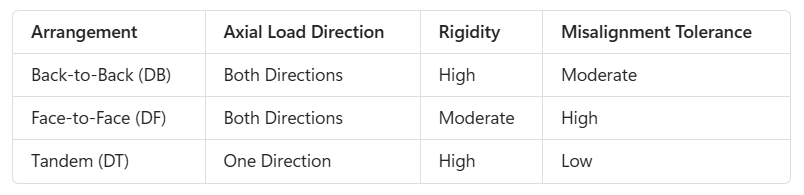
Angular contact ball bearings are frequently installed in matched pairs to support axial loads in both directions, improve shaft rigidity, and increase load-carrying capacity. The arrangement selected depends on the application's operating conditions and design requirements.
Back-to-Back Arrangement (DB)
In a back-to-back arrangement, the load lines spread outward away from each other.
Advantages:
-
- High moment load capacity
- Excellent shaft rigidity
- Better resistance to misalignment forces
- Commonly used in machine tool spindles
Because of its stability and stiffness, the back-to-back arrangement is one of the most widely used configurations in precision equipment.
Face-to-Face Arrangement (DF)
In a face-to-face arrangement, the load lines converge toward the center of the bearing set.
Advantages:
-
- Better accommodation of minor shaft misalignment
- Good axial load support in both directions
- Easier installation and adjustment
This arrangement is commonly used where alignment conditions are less critical than maximum rigidity.
Tandem Arrangement (DT)
In a tandem arrangement, both bearings face the same direction and share axial loads.
Advantages:
-
- Increased axial load capacity
- Load distributed across multiple bearings
- Ideal for high thrust applications
A tandem arrangement supports axial loads in only one direction and is often paired with additional bearings to support reverse thrust loads.
How Do You Choose an Angular Contact Ball Bearing?
When selecting an angular contact ball bearing, consider:
- Required radial load
- Required axial (thrust) load
- Operating speed
- Mounting arrangement
- Desired precision level
- Lubrication method
- Operating temperature
A higher contact angle generally improves thrust capacity, while lower contact angles support higher speeds.
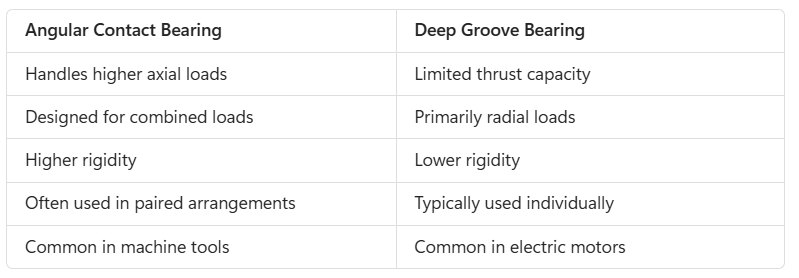
What Is the Difference Between Angular Contact and Deep Groove Ball Bearings?
How Do You Install and Maintain Angular Contact Ball Bearings?
Proper installation and maintenance are crucial for ensuring the optimal performance and longevity of Angular Contact Ball Bearings. During installation, it is important to ensure that the bearings are correctly aligned and properly lubricated.
Proper alignment involves carefully positioning the bearings to minimize any misalignment or uneven loading, which can lead to premature wear and damage. By aligning the bearings correctly, engineers and technicians can maximize the load-carrying capacity and efficiency of the bearings, ultimately enhancing the overall performance of the machinery. Additionally, ensuring that the bearings are properly lubricated during installation is essential for smooth operation and preventing friction-induced wear.
When it comes to the lubrication of Angular Contact Ball Bearings, there are different types that can be used to ensure optimal performance and longevity. Some common lubrication methods include grease lubrication, oil lubrication, and solid lubricants.
Grease lubrication is a popular choice for its simplicity and ability to provide long-lasting lubrication.
Oil lubrication, on the other hand, offers higher speeds and lower friction, making it ideal for high-speed applications.
Solid lubricants, such as graphite or molybdenum disulfide, are often used in extreme conditions where traditional lubricants may not be effective.
Choosing the right lubrication method for Angular Contact Ball Bearings is essential to ensure smooth operation and prevent premature wear and damage. By properly lubricating these bearings, engineers and technicians can maximize their performance and reliability in various machinery applications.
Regular maintenance, including cleaning and re-greasing, should be performed to prevent contamination and ensure smooth operation. It is also important to monitor the bearings for any signs of wear or damage and replace them if necessary.
What Industries Use Angular Contact Ball Bearings?
Angular Contact Ball Bearings are used in a wide range of applications across various industries. They are commonly found in automotive systems, machine tools, robotics, medical devices and aerospace equipment.
When it comes to machine tools, Angular Contact Ball Bearings play a crucial role in ensuring optimal performance and efficiency. These precision bearings are ideal for applications where high rotational speeds and precise positioning are essential. In machine tools, specific examples of Angular Contact Ball Bearings include those used in spindle units, where the bearings must support high speeds and heavy cutting forces. Additionally, Angular Contact Ball Bearings are commonly found in precision grinding machines, ensuring smooth and accurate operation during the grinding process.
These bearings are particularly well-suited for applications that require high precision, such as in medical devices and measuring instruments. For example, in medical imaging equipment like MRI machines, Angular Contact Ball Bearings are found in the rotating components that require smooth and precise movement.
In the aerospace sector, Angular Contact Ball Bearings play a critical role in ensuring the smooth operation and reliability of various components. For instance, in aircraft engines, Angular Contact Ball Bearings are utilized in critical rotating parts to support the high speeds and heavy loads experienced during flight. Whether it's in aircraft landing gear, control systems, or propulsion systems, Angular Contact Ball Bearings prove their worth by providing the necessary support for high-performance aerospace applications.
Frequently Asked Questions About Angular Contact Ball Bearings
What are angular contact ball bearings used for?
Angular contact ball bearings are used in applications requiring both radial and axial load support, including pumps, gearboxes, machine tool spindles, robotics, electric motors, and aerospace systems.
Can angular contact bearings handle thrust loads?
Yes. Angular contact ball bearings are specifically designed to handle thrust loads while maintaining radial load capacity.
Do angular contact bearings need to be mounted in pairs?
Many applications use matched pairs in back-to-back, face-to-face, or tandem arrangements to support loads in multiple directions and increase rigidity.
Which contact angle is best?
The ideal contact angle depends on the application. Lower angles typically support higher speeds, while larger angles provide greater axial load capacity.
How long do angular contact bearings last?
Bearing life depends on load, speed, lubrication, contamination levels, alignment, and operating conditions. Proper maintenance significantly extends service life.
What is the difference between back-to-back and face-to-face angular contact bearings?
Back-to-back arrangements provide greater rigidity and better resistance to overturning moments, while face-to-face arrangements are more forgiving of shaft misalignment.
When should tandem angular contact bearings be used?
Tandem arrangements are used when axial loads exceed the capacity of a single bearing and additional thrust capacity is required.
Which angular contact bearing arrangement is best for machine tool spindles?
Back-to-back arrangements are commonly preferred because they provide the highest rigidity and moment load resistance.
Angular Contact Ball Bearings are essential components in various machinery applications, offering high load-carrying capacity, efficiency, and versatility. From single row to four-point contact bearings, each type has its unique design and characteristics to meet different needs. Proper installation, maintenance, and lubrication are crucial for maximizing the performance and longevity of these bearings. With applications ranging from automotive systems to aerospace equipment, Angular Contact Ball Bearings play a critical role in ensuring smooth operation and reliability.

Need Help Finding Angular Contact Ball Bearings?
BDS supplies angular contact ball bearings for industrial, aerospace, OEM, and MRO applications. With over 600,000 SKUs and access to hard-to-find inventory, our team can help distributors identify replacements, cross references, and custom solutions. We also offer bearing modification, repair, and manufacturing services when standard products are unavailable.